
Just down the Village at Breckenridge steps from the plaza to the Blue River lays a the site of a piece of Breckenridge history. For more than three decades, the Bell Tower Mall stood as a recognizable landmark at the south end of Breckenridge, Colorado—an artifact of 1970s mountain‑town commercial development and a gathering place for both locals and visitors. Though demolished in the early 2000s, its legacy continues to shape how residents remember Breckenridge’s evolution from a quiet mining town into a modern ski‑destination community.
A Bold Commercial Vision in the Early 1970s
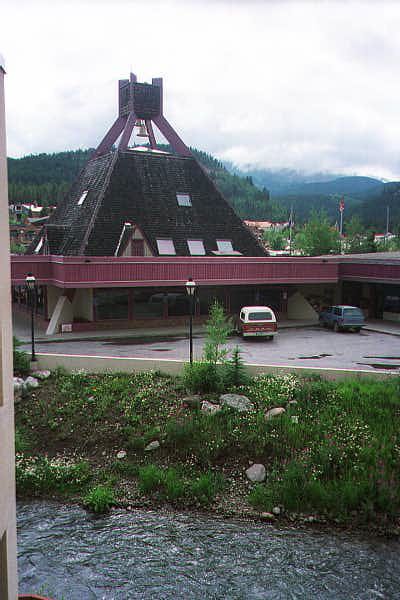
The Bell Tower Mall was constructed in 1971 on the west side of Main Street, near the southern entrance to town. The structure encompassed 45,000 square feet and featured a distinctive pyramid hip roof, which made it instantly recognizable against the backdrop of the Tenmile Range.
Its development coincided with significant growth in Summit County. The Breckenridge Ski Area had opened only a decade earlier (1961), and by the 1970s, Breckenridge was transitioning from a mining‑focused community into a recreational hub. The Bell Tower Mall emerged as one of the town’s earliest attempts at building modern retail infrastructure to support expanding tourism.
A Gathering Place for Locals and Visitors
During the 1970s and 1980s, the mall hosted restaurants, boutiques, and local services. Longtime residents recalled it as a social hub, a place where families gathered after ski days or celebrated at local eateries. One resident quoted during the mall’s demolition reminisced, “I tell you, this was the place to be,” describing long dinners and community gatherings during the mall’s heyday.
Across Main Street sat the Tannhauser Condos, the first of which was built in 1972, with a second building following in 1974—another sign of the increasing density and demand for lodging near the ski area.

Changing Economic Pressures and Growing Pains
By the 1980s and 1990s, Breckenridge’s growth created mounting pressure on available land. The town had zoned the area around the mall for high density, and developers proposed large buildings—some reaching nine or ten stories. Town officials ultimately rejected those plans, fearing they would exceed the community’s “carrying capacity” and disrupt the town’s scale.
Meanwhile, the Bell Tower Mall—though beloved—was aging. Commercial real estate in mountain towns is often valued more for its land than its structures, and as newer developments arose around Breckenridge, the mall struggled to stay competitive.
Demolition and Community Farewell (2002)
In 2002, after more than 30 years of operation, the Bell Tower Mall was demolished to make way for a modern mixed‑use redevelopment known as Main Street Station. The demolition became a community event. Locals gathered to celebrate the mall’s legacy, and the mayor symbolically triggered fireworks to mark “the end of an era.” Although the explosion was just for show, a backhoe ceremonially tore down a corner of the building as a crowd cheered.
Before demolition, salvage crews—including Habitat for Humanity—carefully removed materials such as fixtures, doors, and windows for reuse, reflecting a community ethos of recycling and sustainability.
The Transformation Into Main Street Station
The site was incorporated into a major redevelopment project by East‑West Partners: a three‑phase, $110 million mixed‑use complex with retail space and approximately 200 upscale condominiums. The vision fit the town’s updated development goals while offering a more modern and efficient use of the centrally located parcel.
The new project ultimately became known as Main Street Station, a vibrant retail and residential center that continues to anchor the south end of Breckenridge today. Historical records confirm that the Bell Tower Mall was demolished specifically to make room for this transition.
A Physical Structure Gone, But Not Forgotten
Today, the Bell Tower Mall exists only in historical photographs and local memory. The Breckenridge History Archives preserve images from 1972, showing the mall shortly after construction—its distinctive roofline visible among early 1970s buildings.
For longtime residents, the Bell Tower Mall represents more than a demolished building; it symbolizes a formative period when Breckenridge was growing quickly but still felt small and closely knit. Its disappearance marked not just redevelopment, but a moment of transition between Breckenridge’s rustic past and its modern identity.