
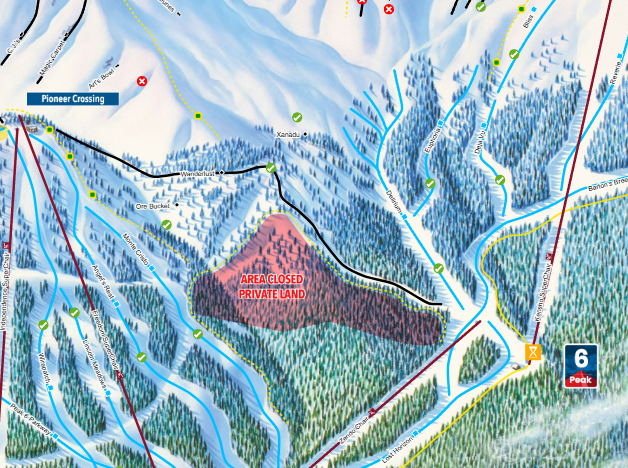
If you ski on Peak 6, you have probably noticed an odd section of land on the ski resort map that is marked as a closed area. This private parcel on Peak 6 is a roughly 10‑acre historic mining inholding, completely surrounded by U.S. Forest Service land that is leased to Vail Resorts for ski operations. While Peak 6 itself is now part of Breckenridge Ski Resort, this single parcel is not owned by the resort or the Forest Service, making it a rare and legally protected exception within the ski area boundary.
Locals sometimes call it the Tailor Lode, its original mining-claim name.
Origins: 19th‑Century Mining Claims
Like much of Summit County, Peak 6 was heavily prospected during Colorado’s mining era (late 1800s). Mining claims from that time were often patented, meaning they became private property that continued to exist even after surrounding lands reverted to federal ownership.
The Peak 6 parcel is one of those remnants—a patented mining claim that legally survived the establishment of the White River National Forest and later ski resort expansions.
Modern Ownership (1960s–Present)
Acquisition in 1962
The parcel was purchased in 1962 by Robert Sasick, a private individual, during the early growth of Breckenridge as a ski destination. Importantly, this occurred before Peak 6 was developed for lift‑served skiing decades later.
Continued Private Status
- Sasick retained ownership even as Breckenridge expanded Peaks 7 and later Peak 6.
- The parcel remained an inholding, surrounded by Forest Service land managed under a ski-area special‑use permit granted to Breckenridge Ski Resort (now Vail Resorts).
The Peak 6 Expansion Controversy (2008–2013)
Public Attention in 2008
When Breckenridge announced plans to expand terrain onto Peak 6, the private land suddenly became highly visible. Sasick publicly marketed the parcel for sale, launching a website and drawing attention to its strategic location near planned lift and trail alignments.
Key facts at the time:
- The land sat between Peak 7 and the new Peak 6 terrain
- One corner lay about 1,500 feet from the proposed Peak 6 lift
- A section of Cucumber Creek runs through the property
Development Limits
Despite its value, development was highly restricted:
- Zoned “backcountry” by Summit County
- Maximum allowed structure ~1,200 sq ft
- Any access would require a U.S. Forest Service special‑use permit, including environmental review
The Forest Service indicated it would prefer to acquire the land through a trade, but no transaction was finalized.
Peak 6 Opens — The Inholding Remains (2013)
Peak 6 officially opened for skiing during the 2013–14 season, adding more than 500 acres of terrain. The ski resort’s final designs deliberately worked around the private parcel, leaving a visible gap in trail mapping and skier access routes.
This is why:
- Certain traverses between Peaks 6 and 7 are indirect
- Some lift or trail alignments commonly assumed by skiers don’t exist
Later Ownership and Local Lore
Local planning documents and community discussions indicate the property assemblage known as Tailor Lode later came under ownership associated with Richard Himmelstein, an inventor and entrepreneur, though public records still recognize it as a private mining inholding with extremely limited development rights.
Ski patrollers and locals report:
- No public access
- Occasional limited personal use by the owner
- Strict enforcement of trespass boundaries (even when snow-covered)
Why the Land Is Still Private
Several legal principles protect it:
- Patented mining claims grant full private ownership
- Federal law requires access to inholdings, limiting government leverage
- Eminent domain is rarely pursued for recreational land
- The parcel has modest development potential but high strategic value
As a result, it remains one of the most famous ski‑area inholdings in Colorado.
Why It Matters
The Peak 6 private land is a visible reminder that:
- Ski resorts operate via leases, not ownership, on public land
- Historical mining law still shapes modern recreational infrastructure
- Even major expansions can be constrained by century‑old property rights