
The Blue River Valley Before the Gold Rush
The Blue River Valley was known to the nomadic Ute Tribe for possibly a thousand years before the first skier set foot in this beautiful valley. This lush valley was their summer hunting grounds, interlaced with game trails, riparian willows, and stands of fir and aspen offering shelter and resources. The river itself—cold, fast, and alive with snowmelt—formed part of a larger network of mountain corridors the Ute moved through in a seasonal rhythm tied to ecology, ceremony, and survival. Even in the early 1800s, only the occasional fur trapper or trader ventured up the valley. The terrain was difficult, the seasons unforgiving, and the rewards uncertain. For generations, the river and valley lived primarily in Indigenous time—until word of gold shifted the currents of history almost overnight.
A Sudden Transformation: The 1859 Pikes Peak Gold Rush
That all changed in 1859 during the Pikes Peak Gold Rush when gold was discovered in the Blue River. The valley was flooded with miners and those intent on making their fortunes off the gold trade: suppliers, freighters, hoteliers, blacksmiths, teamsters, and speculators. Trails hardened into wagon roads. Tents multiplied along creek benches, and the soundscape transformed—shovels in gravel, saws cutting lodgepole pine, mules braying under the strain of pack loads, and sluice boxes rattling with rock.
The political geography of the moment exerted an unexpected influence. Seeking federal recognition and the benefits that came with it, town founders named their fledgling settlement Breckinridge (spelled with an “i”) to honor then–Vice President John C. Breckinridge. The gesture helped secure a local post office—an extraordinary achievement for such a remote mountain outpost. After the Civil War, when Breckinridge cast his lot with the Confederacy, the spelling was changed to Breckenridge, reflecting both practical distancing from Confederate associations and the town’s evolving identity. But in the summer of 1859, Breckinridge was mostly a scatter of tents and a handful of log cabins, stitched along the valley floor between the Blue River and the rising slopes of the Tenmile Range.
General George E. Spencer—whose frontier activities included roles in organizing settlement and political infrastructure—figures in some local accounts of early civic development in the region. Whether he stood hammer in hand on the very first buildings or operated more as a facilitator and booster, his name appears amid the cluster of personalities who helped give civic shape to a rapidly forming town. Either way, the essential dynamic was clear: Breckinridge grew from a mining camp into a mountain community because hundreds of individuals were staking claims, hauling ore, opening shops, planning roads, and building families in a place that most maps barely acknowledged.
Claiming the Ground: Placer and Hard-Rock Mining
Gold drew people to the valley, but the gold itself came in different forms and demanded evolving methods. Placer mining—the simple, surface-level extraction of gold flakes and nuggets from sand and gravel—dominated the first wave. Prospectors swirled pans in cold eddies, built rockers and long toms, and soon graduated to sluice boxes that allowed more throughput. Water, as always, was both a resource and the central constraint. Channels were diverted and riffles laid, and crews learned quickly which bends and bars held promise.

As the most accessible placer deposits were exhausted, attention turned to lode mining—hard‑rock operations aimed at veins of gold-bearing quartz within the mountains themselves. This called for new skills, capital, and infrastructure: adits and shafts driven into bedrock; timbering to prevent collapse; hoisting works; ore carts; stamp mills; and smelting arrangements that linked Breckenridge to a wider regional economy. The valley’s hillsides and gulches—French Gulch, Illinois Gulch, and others—began to sprout mine portals and waste rock piles. The work was grueling and often dangerous: blast fumes and weak supports, freezing water seepage, rock falls, and powder mishaps. Yet throughout the 1860s and 1870s, lode mining anchored Breckenridge’s rise from a tent city to a stable mountain town.
Breckinridge Becomes Breckenridge: A Town Takes Shape (1859–1865)
By the summer of 1860, Breckinridge had a U.S. post office, stores, hotels, a county government, and—of course—saloons. Blacksmiths repaired tools and shod mules; stables and freight operations tied the camp to the plains; boarding houses provided warm (if cramped) bunks for men far from home. Churches followed, then schools, reflecting the presence of families and a desire for continuity in a volatile setting. A newspaper might spring up, burn down in a fire, and reappear, mirroring the town’s boom‑and‑bust cadence.

Local governance developed in parallel with the economy. Claim disputes needed adjudication. Water rights—so central to placer mining and milling—had to be negotiated, recorded, and defended. Rough forms of law enforcement emerged, ranging from elected constables to ad hoc vigilance committees in the rougher years. As civic life matured, the town’s palate broadened: dances in the winter, public lectures, fraternal lodges, and the slow but real refinement of frontier tastes—better coffee, better flour, a wider array of tools, and the occasional piano hauled over mountain passes at extraordinary effort.
In these early years, the name change from Breckinridge to Breckenridge crystallized the town’s turning outward from Civil War politics toward the durable concerns of mountain life: keeping roads open, schools funded, and mine shafts supported. It was a symbolic reset as much as a practical one, and the spelling we know today became the vessel for a growing identity.
Transportation and the Art of Connection
Every mining town’s fate was entangled with transportation. Supplies came in from Denver and the Eastern Plains by wagon, crossing high country passes that were treacherous in fair weather and nearly impassable in deep winter. Freight costs inflated prices. A nail, a pound of coffee, a pickaxe—each carried a premium born of distance and danger.
The arrival of the Denver, South Park & Pacific Railroad to the Breckenridge area in the early 1880s via Boreas Pass changed that equation. The railroad, itself an engineering marvel of high‑elevation track and winter snow‑fighting, helped bring in heavy machinery—boilers, stamps, air compressors—and enabled larger-scale industrial mining. It also allowed outflow: ore could be hauled to smelters more efficiently, and local businesses could receive more regular deliveries, smoothing the bite of scarcity. Rail connections helped integrate Breckenridge into a regional economy linking Leadville, Fairplay, Georgetown, and Denver, each town playing a role in the complex choreography of mining, milling, finance, and trade.
Roads improved—graded, drained, bridged. Freight lines refined schedules to sync with railroad timetables. In winter, sleighs and sledges kept goods moving when wagon wheels failed. To live in Breckenridge in these years was to live at the edge of weather and terrain, but also at the center of ingenuity.
Society, Labor, and the Texture of Town Life
Mining towns were never just about mining. The social world of Breckenridge was a tapestry woven from many threads: Cornish and Irish hard‑rock miners with deep traditions of underground work; German and Scandinavian carpenters and millwrights; prospectors from Missouri and Illinois who had drifted west through earlier booms; and a mosaic of entrepreneurs with the knack of making money when others only made dust.
Saloons and dance halls ranged from raucous to respectable. Boarding houses offered a semblance of family life even to solitary men. General stores functioned as both supply points and news hubs—a place to pick up a pound of beans and the latest rumor of a strike up French Gulch. Churches formed the backbone of civic moral life, holding picnics and fundraisers, sponsoring choirs, and supporting families through illness and grief. Schools slowly stabilized as families became more rooted, and summer’s nonstop labor gave way to seasonal rhythms—mining in fair weather, wood cutting and equipment repair in the winter, with time carved out for community events.
Work was risky. Injuries were common, and mutual aid—whether formalized through fraternal orders or informal among bunkmates—was essential. The town occasionally faced fire, that persistent peril of wood-frame settlements. Each time, rebuilding called forth both collective will and outside capital, reasserting the town’s stubbornness against misfortune.
Technology and the Landscape: From Picks to Dredges
The arc of mining technique etched itself onto the valley’s geography. Early placer mining left modest traces—piles of rounded cobbles and small tailings, an altered riffle here, a nibbled bank there. Lode mining left shafts, adits, waste rock dumps, and, higher up, abandoned aerial tram towers that were once used to carry ore buckets down to mills.
By the late 19th century, large‑scale dredge mining arrived—floating behemoths that essentially “ate” the riverbed, processing huge volumes of gravel and depositing the tailings behind them in long, sinuous arcs. The resulting cobble fields still mark parts of the Blue River corridor today, a permanent record of an era when industrial ambition overtook the valley at a scale unimaginable to the first panners of 1859. Dredges represented both technological prowess and an environmental pivot—extracting value by literally rearranging the valley floor.

Mill technology evolved in step. Stamp mills crushed ore; mercury amalgamation and later cyanide processes improved recovery; and ventilation and pumping systems allowed deeper workings. Capital costs soared, pushing ownership from solitary prospectors toward companies and syndicates with the resources to finance machinery, supplies, and payrolls through the long winters.
Booms, Busts, and the Wider Economy (1870s–1890s)
The prosperity of a mountain town was always conditional—a negotiation with ore grades, metal prices, and the weather. The Silver Boom of the 1870s and 1880s, centered in places like Leadville, echoed across the region, bringing investors, new machine shops, and a surge of population that spilled into Breckenridge. With more people came more commerce: better hotels, more refined restaurants, even photography studios to send images “back East.”
Then came the Panic of 1893 and the collapse of silver prices, a shock that rippled through all mountain towns, even those primarily focused on gold. Breckenridge absorbed the blow with a shift back toward gold and with efficiencies afforded by rail transport and technology—especially the dredges that, by the mid‑1890s into the early 20th century, would wring fresh profits from ground once considered played out. Those years taught the community a hard lesson in economic resilience: the only certainty was change.
Law, Order, and the Frontier’s Edge
The romanticized image of the “wild” West often overlooks the extent to which citizens craved order—contracts that meant something, ore shipments that weren’t hijacked, and courts that could settle disputes without resort to fists or firearms. Breckenridge was no exception. Claim boundaries were posted and recorded; water uses documented; and when allegations of claim jumping or theft did arise, miners’ courts or county officials stepped in. The presence of elected officials, a functioning post office, and eventually a courthouse put a civic frame around the rough-and tumble enterprise of extracting mineral wealth.
Yet frontier uncertainty always hummed in the background. Seasonal scarcity could stir tensions. A single snowstorm could isolate town for weeks; a single fire could change a block’s fate. In that crucible, a certain Breckenridge character took root—practical, neighborly, and strong-willed.
Winter in the High Country: Survival and Community
Winter defined life in Breckenridge as surely as gold defined its economy. Snow drifted over sheds and outbuildings. Roofs were swept in a daily ritual to prevent cave-ins. The river cinched into ice, and woodpiles diminished at a rate that forced careful accounting. Sleds carried provisions when wheels could not, and families sealed windows with cloth and newspaper against drafts. Yet winter also fostered community: card games, dances, socials, holiday gatherings, and the simple pleasure of a lamp-lit parlor. Musicians tuned fiddles; storytellers recounted strikes and close calls underground; and children, hearing the talk of grades and assays, learned the language of the place.
Early skiing—long before chairlifts—entered life as a practical means of getting around, with handmade “Norwegian snowshoes” used to cross drifts and ferry messages. The seeds of a future winter economy, built on recreation rather than extraction, were sown in these pragmatic adaptations to snowbound living.
The Blue River Valley: A Longer View of Place
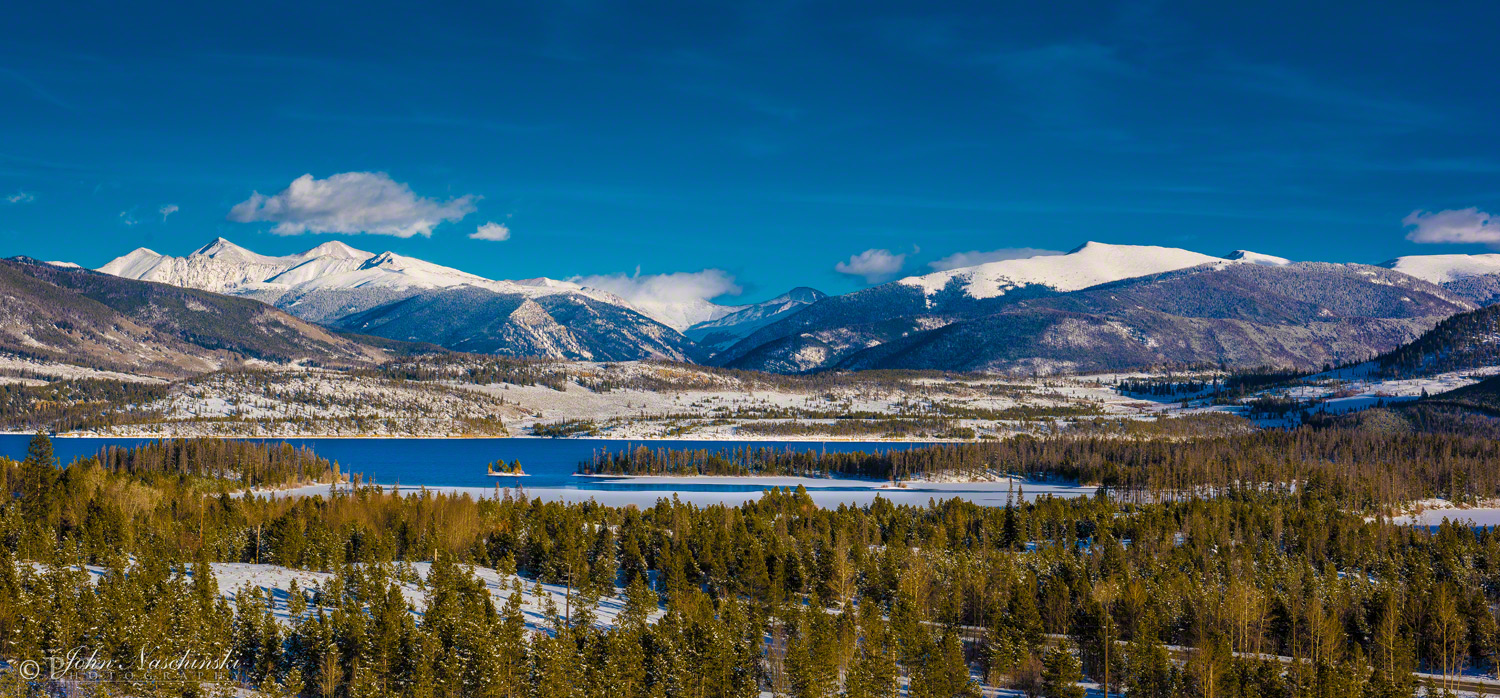
To understand Breckenridge is to understand the Blue River Valley that cradles it. The Blue River rises from high alpine basins near Hoosier Pass and Quandary Peak, gathers snowmelt from the Tenmile and Gore Ranges, and runs northward toward the Colorado River. Its valley meadows, willow-choked oxbows, and beaver-engineered wetlands once offered ideal conditions for Ute summer hunting. The valley functioned as a biodiverse seam through the mountains, stitched together by waters that rose and fell with each season.
The gold rush layered a new set of uses onto that landscape. Water became a tool as well as a habitat, diverted into ditches to power sluices, turned within flumes, and ultimately pushed through the wash of dredge buckets. Forests became timber supplies for mine supports, cabins, and mills. By the 1890s, a visitor could read the valley’s history at a glance: the old camps and adits on the benchlands; the railroad grade cutting across a slope; the riparian corridor reshaped by dredge tailings; and, still, above it all, the enduring alpine ridgelines, where storms formed and the snowpack reset the watershed each winter.
The 20th century would bring yet another transformation with reservoirs, modern roads, and a vibrant recreation economy. But the period from the 1850s to 1900 fixed the valley’s transition from Indigenous seasonal ground to a permanent settlement whose fate rose and fell with the price of gold and the nerve of those who chased it.
Notable Episodes and Landmarks
- French Gulch: One of the most productive mining districts near Breckenridge, rich in both placer and lode deposits. It became a case study in the progression from pan to pick to stamp mill.
- Boreas Pass Road and Railroad: The wagon road over Boreas Pass predated the rail, but the Denver, South Park & Pacific line’s arrival via this high pass was a turning point, enabling large-scale equipment transport and better winter logistics.
- Dredge Era Signatures: The cobble fields and sinuous tailings piles along parts of the Blue River corridor are living geomorphic documents—material evidence of late‑19th‑century industrial dredging that continued into the early 20th century.
- Civic Anchors: Post office, courthouse presence, schools, and churches marked Breckenridge’s shift from a transient boomtown to a true community with a commitment to continuity.
Environment and Consequence
Mining’s environmental legacy is complex. On one hand, gold and later silver fueled economic development, brought railroads, and seeded permanent mountain culture. On the other, mercury from amalgamation, disrupted riverbeds, and compromised riparian habitats left problems that later generations would have to address. The Blue River Valley’s restoration and conservation efforts in the 20th and 21st centuries—stabilizing banks, re‑meandering channels, remediating tailings, and reviving wetlands—reflect both a reckoning with that legacy and a reaffirmation of the valley’s ecological value. In this way, the story of Breckenridge is not just about extraction, but about learning new ways to live with the land.
People Behind the Headlines
Histories of towns often highlight a few marquee names—founders, financiers, politicians. But Breckenridge’s true authors were the thousands of unnamed people who carved its daily life. The miner who set timbers in a cold drift; the teamster who coaxed a six‑horse rig up an icy grade; the shopkeeper who extended credit through a lean winter; the teacher who kept a class attentive while a storm rattled the windows; the doctor who carried his bag by lantern‑light to a boarding house; the carpenter who raised a steeple with hand tools and grit. Their work filled the space between dates, and their choices built the culture that allowed the town to outlast individual mines.
1890–1900: Consolidation and Looking Ahead
By the 1890s, Breckenridge had passed through its initial waves of tumult and achieved a kind of high-country normal: a functioning civic structure, established neighborhoods, regular freight and rail ties, and a diversified local economy that—while still mining-heavy—supported merchants, hoteliers, and a modest professional class. The Panic of 1893 rattled the region, but dredge operations and improved hard‑rock techniques sustained output. Winters were still hard. Fires still flared. Yet the sense that Breckenridge would endure had settled in.
The closing years of the 19th century set the stage for the 20th: new technologies, changing markets, and, eventually, a recasting of the valley around recreation and heritage rather than extraction. The same mountains that shed gold flakes into the Blue River would, in time, draw visitors for snow and sun rather than ore. And the town’s historic core—false fronts, hewn beams, narrow lots—would become an asset in its own right, a tangible link to an era when everything depended on the next assay and the next delivery over the pass.
Legacy
From 1859 to 1900, Breckenridge traveled a long arc—from an improvised cluster of shacks along a high-country river to a resilient mountain town with a durable identity. The Blue River Valley, once a quiet summer ground for the Ute, became a corridor of industrial ambition and then a landscape of layered histories—Indigenous, mining, civic, environmental. Today’s visitors walk streets laid out in the era of pan and pick, cross a river once flumed and dredged, and look up at peaks that have watched all of it: migration, rush, boom, bust, and renewal.
The story’s essential thread is continuity through change. People came for gold and stayed for community. They adapted methods, rebuilt after fires, engineered rail lines over improbable passes, and learned, slowly, to balance the valley’s economic potential with its ecological and cultural value. Breckenridge’s buildings, riverbanks, and trails are the archive of that learning, written in timber, stone, water, and snow.